

Nextlogic

The Next-Generation Urban Freight Logistics for Net-Zero Emissions through Innovative Solutions (NEXTLOGIC) project is a four-year Horizon Europe-funded project supporting cities in their transition towards climate neutrality by developing smarter and more sustainable approaches to urban mobility and logistics.

While much attention has traditionally focused on how people move around cities, the delivery of goods also has an important impact on traffic, emissions and the use of public space.

NEXTLOGIC explores how digital technologies, data and innovative logistics solutions can help cities organise deliveries more efficiently, make better use of urban space, and reduce transport emissions.


NEXTLOGIC brings together cities, researchers, logistics operators, businesses and citizens to develop and test solutions adapted to different urban environments.

The project uses Digital Twins – digital representations of real urban environments – together with data and other digital tools to analyse mobility and logistics and test possible solutions before implementing them in the real world.

These solutions include Smart Loading Zones, zero-emission microhubs, multimodal hubs, electric mobility and charging infrastructure.

Cities need to reduce transport emissions while managing limited urban space and ensuring that both people and goods can move efficiently.

NEXTLOGIC helps cities explore ways to make deliveries cleaner and more efficient, use urban space more effectively and better integrate deliveries into mobility planning.

By combining digital tools with real-world testing, the project aims to contribute to lower emissions, better use of public space and cleaner, more liveable neighbourhoods.

NEXTLOGIC brings together 34 partners from 13 countries and is funded by the European Union under the Horizon Europe research and innovation programme (grant agreement No. 101238585). The project is coordinated by the University of Luxembourg.

 The consortium is developing and testing solutions in eight European pilot cities: Aarhus, Dublin, The Hague, Wrocław, Bergamo, Differdange, Frankfurt and Heidelberg. Differdange is the only Luxembourgish city participating in NEXTLOGIC.

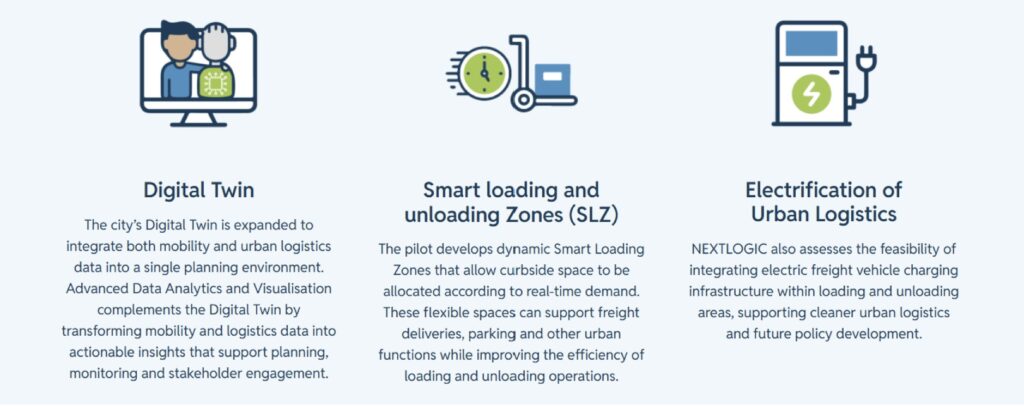
In NEXTLOGIC, Differdange combines digital planning technologies with innovative urban logistics solutions. The city focuses on Smart Loading Zones (SLZs) to better organise delivery and loading activities in the city centre. Building on a solution developed in The Hague, the pilot explores how loading zones can be managed more flexibly according to demand, helping to make better use of limited public space.

The pilot will also expand Differdange’s existing Digital Twin to integrate mobility and logistics data and support data-driven urban planning. It will explore how charging infrastructure for electric freight vehiclescould be integrated into loading and unloading areas.

Together with local partners – Parkunload and the Cluster for Logistics Luxembourg (C4L) – as well as researchers from the University of Luxembourg, the City of Differdange is developing and testing the pilot.

Through NEXTLOGIC, Differdange aims to:

  • explore and test Smart Loading Zones for urban deliveries;
  • improve the use of loading and unloading areas and limited curbside space;
  • integrate mobility and logistics data into the city’s Digital Twin;
  • explore the integration of electric freight vehicle charging with loading zones;
  • assess solutions that could support cleaner and more efficient urban logistics.

These activities aim to contribute to cleaner and more efficient deliveries, better use of public space and Differdange’s transition towards climate neutrality.

Follow the project: NEXTLOGIC website to discover the latest news on project activities, pilots, results and developments.

For local information and updates, visit Differdange – NEXTLOGIC Project and follow the City of Differdange on Facebook, Instagram and LinkedIn.

NEXTLOGIC is funded by the European Union’s Horizon Europe research and innovation programme and is part of the CIVITAS Initiative. Views and opinions expressed are, however, those of the author(s) only and do not necessarily reflect those of the European Union or the granting authority. Neither the European Union nor the granting authority can be held responsible for them.