Now
Never lend out your bank account: Police warn young people about money mules
The City of Differdange is promoting the Grand Duchy of Luxembourg Police’s new awareness campaign against “money mules,” a form of money laundering that is increasingly targeting young people in Luxembourg.
A campaign designed by young people, for young people.
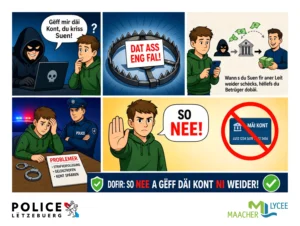
Receiving money in your account, transferring it elsewhere, and earning a small commission in the process: it sounds like a great deal offered on Snapchat or via messaging apps, but it’s actually a serious crime. This is the phenomenon of money mulling, which is on the rise among young people in Luxembourg.
To tackle this issue, the Grand Ducal Police launched a collaborative project with Maacher Lycée in early 2026, the results of which have just been presented. The goal: to encourage students to think for themselves about the risks and to design an awareness campaign aimed at their peers, notably featuring a short video.
What is money mulling?
Money mulling is a money-laundering technique. Criminals (phishers or other fraudsters) need to move the money they’ve obtained through their crimes without being detected. To do this, they recruit money mules: people who receive money into their own bank accounts and then transfer it to another account or withdraw it in cash in exchange for a commission.
Victims of this recruitment are often young people or those in precarious financial situations, who are contacted on social media or messaging platforms.
Key Takeaways
- It is illegal to make your bank account or debit card available to third parties.
- Individuals prosecuted for money laundering risk having their accounts frozen, their funds seized, a prison sentence of one to five years and a fine ranging from €1,250 to €1,250,000, as well as mandatory forfeiture.
- If the money cannot be traced, confiscation may extend to other assets of the convicted person, up to the amount of funds that passed through their account.
In case of doubt or a suspicious request: never agree to it, talk to someone you trust, and contact the police.
Audio playback of the page content is active.
Stop playback